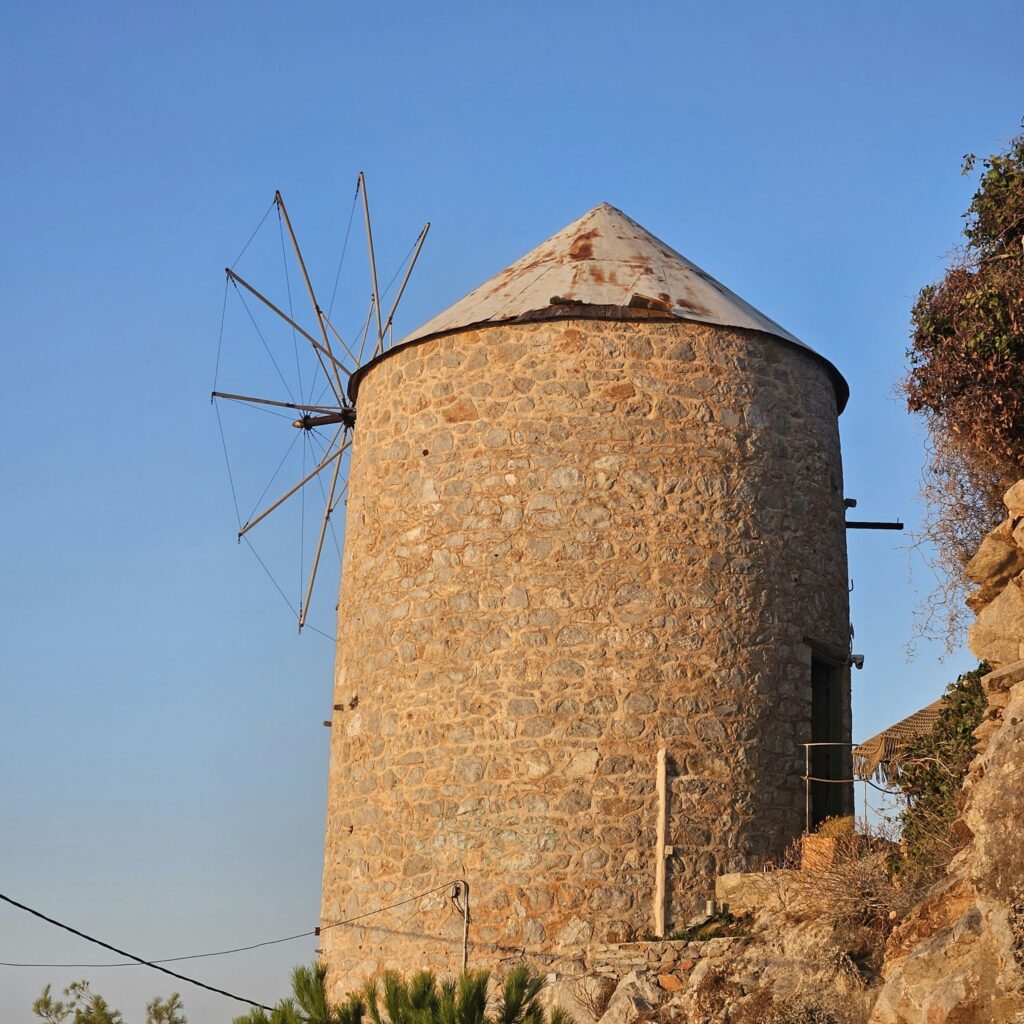
Traditional windmills have long played a key role in local energy use, particularly for water pumping to support irrigation and domestic water supply. A recent study conducted within the CRETE VALLEY framework examines the design and performance of the historic windmills of the Lasithi Plateau in Crete, with the aim of informing the development of small-scale systems for electricity generation.
Titled The Evolution of Windmill Design: From Lasithi Plateau Pumping Windmills to Electricity Production, the study investigates the aerodynamic and structural behaviour of a traditional horizontal-axis windmill equipped with a passively controlled fabric-sail rotor system. These windmills, historically used for water pumping, serve as the conceptual basis for their evolution into wind energy systems.
The research analyses the structural characteristics of the traditional design to define the technical specifications for a small-scale wind turbine with a sail-based rotor. It also assesses local meteorological conditions in the Lasithi Plateau to determine operational and extreme working conditions.
Emphasis is given then given to sail geometry, supporting structure, and passive aeroelastic deformation. The study shows that the sail’s ability to deform plays a central role in regulating aerodynamic loads, acting as a natural load-shedding mechanism that enhances performance under high wind speeds of up to 40 m/s.
The results also highlight nonlinear relationships between wind speed, torque, and thrust, pointing to the importance of aeroelastic effects. The woven polyester material used for the sails enables large reversible deformations without mechanical failure, preserving structural integrity.
Overall, the study provides insight into the design and operation of flexible-sail windmills, showing how traditional configurations can support the development of resilient and cost-effective wind-driven systems.
—–





